Showing posts with label CARROTS. Show all posts

11.14.2011

Take note

I have a root vegetable recipe for you today. That seems sort of odd, I realize, given that it's currently 62 degrees outside, but let's keep in mind that it's the weather that isn't seasonal, not the recipe. (Not that I'm complaining! Weather gods take note!)


At any rate, I found the idea for the recipe in this month's Bon Appetit. It was one of those write-ins—someone from South Carolina had eaten at a restaurant in Atlanta and wanted the recipe for a roasted carrot and beet salad. I tucked it aside in my pile of To Make Soon clippings, but when I went to start cooking, I realized the page I ripped out had the ingredients, but not the directions. It didn't look like rocket science—there was a list of dressing like substances, then a pile that sounded more like salad fixings—but when I compared notes later online, it turned out we came to similar places, but via different methods.

I also decided that I wanted it to be more of a salad than just a pile of roasted vegetables, so I saved the beet greens, chopped them up, and added some arugula. I ate it with a piece of pan-seared pollock, and a few slices of grilled bread. And even though the sun was shining and I was wearing a t-shirt and feeling very far away from the root vegetable era, it really hit the spot.

I'm liking this November.

ROASTED BEET AND CARROT SALAD

Here's my version of the Bon Appetit version which in turn was an Empire State South version of a Spotted Pig original! Confusing! But so, so good.

1 teaspoon cumin seeds
juice of 1 lemon
2 teaspoons rice wine vinegar
1 teaspoon Dijon mustard
1/2 cup olive oil plus more for drizzling
salt and pepper to taste
1 pound carrots cut into "carrot stick size" pieces
1/2 pound beets peeled and cut into the same size pieces
1/2 cup lightly packed finely chopped parsley
1/4 cup finely chopped fresh mint leaves
a handful of washed and torn beet greens
a handful of washed and torn arugula
1/2 cup crumbled feta

Preheat the oven to 400 degrees F. Toast the cumin seeds over medium heat in a small dry skillet, stirring often. When they start to get fragrant (3-4 minutes), they're done. Grind them up using a mortar and pestle.

Whisk together the ground cumin seeds, lemon juice, vinegar, Dijon mustard, and 1/2 cup of the olive oil in a small bowl. Season with salt and pepper and set aside.

Combine the carrots and beets in a Pyrex dish. Drizzle them with olive oil and roast them in the oven for 25-30 minutes, or until just tender. Transfer the roasted root vegetables to a salad bowl and toss them with the reserved dressing, parsley, mint, beet greens, and arugula. Crumble the feta over top and serve at once.

Note: I ate my salad with the vegetables hot, but they could also be roasted ahead of time and served either at room temperature or even straight from the fridge.

7.25.2011

A garden recipe

Sometimes, I imagine our lives through the neighbors' eyes, through the windows across the street.

I notice a routine: a man up early, the green Chevy pulling away. A woman—now noticably round—out in the briars each morning in her nightgown and bare feet. She brings an old pint container for the berries: first the black, then the red, now the golden raspberries.


She snacks while she picks—then waters the carrots, checks the kale and broccoli for the little green worms that devour holes in the leaves. She disappears inside and then is back on the front stoop. A black lab settles onto the brick beside her, and she spoons something out of a porcelain bowl—granola and yogurt maybe, with a handful of berries.

Later in the day, she might come out and weed. The tomatoes need trimming, and the butternut squash vines are growing almost clear across the street. She checks the orchard—there were five ripe peaches before the birds stole two the other day—and sprays horticultural oil on the new pear leaves. She ties a loose asparagus fern to the others around the stake, pulls a few heads of lettuce.

Then she drives off, too—off to the restaurant in black skirt and shoes—and the yard is quiet for another afternoon.

GARDEN SALAD

We haven't been eating anything complicated recently. There's too much good fresh food to bother fussing with recipes and heat. But here's a suggestion for a simple salad with a tried and true dressing recipe that's good on just about any chilled spread of garden-fresh veggies. This recipe serves 2.

1/3 cup white vinegar
2 tablespoons olive oil
1 teaspoon sugar
1 teaspoon ground black pepper
1/2 teaspoon salt
2 medium cucumbers, thinly sliced
2 ears of fresh corn, shucked and kernels cut off the cob
1 pint cherry tomatoes, halved
a handful of Thai basil
4 carrots, sliced into thin rounds
a handful of cheese—I used cheddar, cut into tiny cubes, but I also think goat cheese, shaved Manchego, or Parmesan ribbons would be good

Whisk together the white vinegar, olive oil, sugar, pepper, and salt in a small measuring cup. Set aside.

In a large shallow bowl, layer the cucumbers with the corn, cherry tomato halves, Thai basil leaves, and carrot rounds. Sprinkle or shave the cheese evenly over top. Pour the dressing on, and let the salad marinate at room temperature for at least 10 minutes before serving.

5.16.2011

Satisfying, and beautiful

Hi! I tried to stop in here on Friday, but Blogger was having some kind of meltdown, so I couldn't. I wanted to tell you that the first farmers' market of the season was Saturday morning at eight o'clock sharp in Orleans, and that I was looking forward to seeing you there. I hope you made it.


If you didn't, though, don't worry. Barbara and Gretel and Lucas and the gang will be there every week from now on, and the Provincetown market starts this Saturday. There's also a new farmers' market on the block, starting up this Wednesday at the brand-spanking-new Preservation Hall in Wellfleet. I'm not quite sure who will be there yet, but I'm planning on going, and I promise to report back. It is so nice to have a fridge full of local greens and spring carrots and hothouse tomatoes (!) and cucumbers (!) and Ron Backer's asparagus. Finally! It makes me a little giddy.

It is also a good reminder that there are, believe it or not, other food groups besides rhubarb & Meyer lemon desserts. Between the rhubarb pie testing my mother and I have been doing, and last week's attempt at this Shaker Lemon Pie, and the rhubarb-lemon cobbler we talked about two weeks ago, I find it hard to fathom, but according to the Little Caesar lettuces and the French Breakfast radishes, it's true.

And I have to say, it feels pretty good to step back into the salad world. Yesterday, Alex and I had one of those hugely productive Sundays—tidied up, did the laundry, finished the house budget, picked out paint colors, planted squash, planted melons, planted tomatoes, went to the dump, scrubbed the guest room!—and mid-day, we stopped for a quick rest at the kitchen table. We didn't have time for a long break—there were still way too many spiders living in the baseboards—but I wanted to make something a little bit elegant, something pretty and simple.

I pulled out a nice china salad bowl, and three bags of greens from the fridge. I did a little mix-and-match—some of Barbara's butter lettuce, a handful of spicy mustard Mizuna from Rod and Darnell, and a whole bunch of Lucas's baby braising mix. Then I chopped up a tomato, sliced a carrot and cucumber and two radishes thin with the mandolin, and crumbled some goat cheese and gorgonzola on top. It was hardly fancy, but it was satisfying, and beautiful, and with a few slices of baguette and butter, it did the trick.

If you're feeling anything like I am these days—hungry, and busy, and a little too interested in gardening to sit down and make anything terribly fussy or complicated—I highly recommend giving it a whirl.

FIRST OF SPRING TOSSED SALAD

This is hardly complicated enough to count as a recipe, but it's what we've been eating all week, and it's also delicious. Tomatoes and cucumbers are not normally things I associate with spring, but with Ed and Betty's hothouse in full operation, maybe they'll move up permanently on the calendar—keep your fingers crossed, and who knows.

1/8 cup balsamic vinegar
1/4 cup extra virgin olive oil
1/2 teaspoon whole grain mustard
a pinch of salt
freshly cracked pepper
1/2 pound mixed spring greens
1 spring carrot, trimmed and sliced thin
2 French Breakfast radishes, trimmed and sliced thin
1 tomato, chopped into half wedges
1/2 cucumber, sliced thin
a handful of crumbled gorgonzola
a handful of crumbled chevre

Whisk together the balsamic, olive oil, mustard, and salt and pepper to taste in a small pitcher. Be sure to whisk for at least 30 seconds; it takes the mustard a little while to bring the vinegar and oil together and get the whole thing to emulsify. Set the dressing aside.

In a large salad bowl, toss together the greens and other vegetables. Crumble the cheeses on top, dress, and toss well. Serve at once, with a hunk of crusty bread to mop up the extra cheese and dressing and veggie juice.

5.09.2011

Sturdy and fragile

Last May, one very early morning, I went out weir fishing. I was exhausted from work the night before, and not really looking forward to getting up and getting on a boat with all the wet and the cold. But when I got there—when I met Shannon and Ernie and Shareen and motored out and saw the weir—everything changed. I was awake suddenly, wide awake, and the morning was ethereal, magical.


I've never seen anything simultaneously so sturdy and fragile as the weir. It was made of posts—hickory posts, driven deep down into the sea bed—with a series of nets that let the fish in. They could swim out, but they can't figure out how, and so they get trapped—hundreds and hundreds of squid, mackerel, butterfish.
When I got home, I got Alex and Ernie in touch. The Eldgredges sell mostly through a CSF—a community supported fisheries program that's run just like a CSA—but they had enough to sell to Alex, too. Last year, the big run was butterfish, and he got a whole tote full for the markets. His restaurant and the one where I work fried them up and ran them as specials—fish and chips served head on, skeleton in. There were a few leftover for staff meal one night—sweet, rich flesh with tails that crunched like potato chips.


This year, it's mackerel that keeps swimming in. Alex brought some home last night—those glossy bodies up there—silvery, midnight blue, amazingly fresh. We ate them whole, escabeche style, pan fried. I slivered carrots and onions while Alex cleaned the fish—heads off, tails on, guts tossed and body cavity washed out. While he seared I made an olive tapenade—plenty of garlic, green olives, salt.

I'd never really eaten much mackerel, but I was sold pretty quick. Some people think they're oily, but when they're fresh like this, they're fleshy and sweet and rich. The marinade added tang, the tapenade gave them brine, and we both cleaned our plates. There was something about them that was just right—the crisp maybe, or the give. Whatever it was, it fit the night, the mood, the season—so if you have a chance, dig in.


MACKEREL ESCABECHE WITH CARROTS, SHALLOTS, & OLIVE TAPENADE


Escabeche is a Mediterranean thing. The general idea is to take an oily fish, poach or fry it, and serve it with an acidic vegetable marinade. It's also popular in Jamaica, although it tends to be much spicier down there. We adapted this recipe from one we found over here, and found it absolutely delicious.

1/4 cup extra virgin olive oil, plus more for frying
2 large shallots, thinly sliced
2 medium carrots, peeled, trimmed, and cut into 2-inch long slivers
4 sprigs fresh thyme or 2 teaspoons dried
2 bay leaves

3 large garlic cloves, minced, divided
1/3 cup red wine vinegar
salt and freshly ground pepper
1/4 cup minced green olives
four 8 ounce mackerel, guts and heads removed

Heat up the olive oil in a large skillet over medium heat. Add the shallots, carrots, thyme, bay leaves, and a third of the garlic and cook until the vegetables are softened, about 8 minutes. Remove from heat and transfer to a shallow serving dish. Stir in the vinegar, season with salt and pepper, and set aside.
Mix the remaining garlic with the green olives to make the tapenade, then set aside.

Fill the skillet with about 1/4-inch of olive oil. Heat the oil over high heat until shimmering. While you wait, season the mackerel with salt and pepper. When the pan's hot, add them to the skillet and cook until the skin is brown and crisp, about 4 minutes. Turn the fish and cook another 3-4 minutes on the other side, or until the flesh is cooked through and the skin is crisp.

Serve each fish with a large spoonful of the vegetables and their marinade and a sprinkling of olive tapenade on top. Eat from the tail to the head, taking the flesh on the top half first, then gently pulling the skeleton out before eating the rest. About one fish per person makes a good serving.


P.S. If you're looking for local mackerel, Alex thinks he'll be getting it in to his Eastham and Truro markets until about mid-June!

3.28.2011

Speaking of great

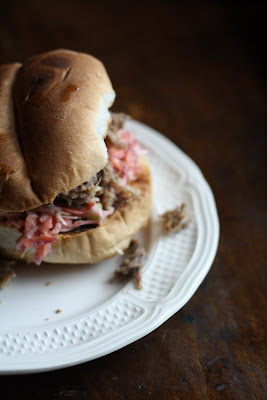
If I could change geography, I would. No offense to Kennebunkport and Kittery and southern New Hampshire and the whole south shore, but I would squish them inland, or maybe shift them south. Then, I'd build a short bridge—I'm thinking five miles or so—from our house in Wellfleet to my sister's doorstep in Portland, Maine. My parents would only be a half hour's drive north, and we could all get together and cook and eat and sit around on Sundays. It would be just like last Sunday, when my sister and I both made pulled pork, except we could make it in the same pot, do half the dishes, and have twice the fun. It would be great.


Speaking of great, I should say a few things about the pulled pork. First off, I'd like to thank Martha—you know, the Martha—for making it all so easy. I have to admit that before I found her recipe I was sort of intimated by pulled pork, and when you routinely have half a pig in your freezer, that is not a good way to be. I was under the impression that you needed a crock pot, or possibly even a fire pit, but Martha straightened me out. She showed me that you can make excellent pulled pork with very few ingredients in your very own oven in less than three hours, and that it will be so good that even your husband will declare it "North Carolina Tasty."

It's easy. All you need is some pork shoulder (also known as pork butt)—we used two pork butt steaks with the bones still in—a bit of brown sugar, some cayenne pepper, minced garlic, and a few cups of apple cider vinegar. Seriously, that's it. Oh, and an oven. I also added homemade coleslaw and some Portuguese rolls, but that was for sandwiches. All in all, it made for an excellent experience.

Now we'll just have to wait for the next pig, and a new shoulder to experiment with. And maybe, just maybe, one day we'll build that bridge.

PULLED PORK

This is an excellent way to use pork shoulder—whether you have it as one big hunk or it's divided into steaks. Martha calls for boneless shoulder, but I don't think it really matters. We left the bones in and ours came out excellent.

When it comes time to toss the cooked meat with the pan juices, don't be afraid of adding the fat back in—if the meat is from a pastured animal, this is where you'll not only get your flavor but also a lot of top notch nutrients.

1/4 cup packed brown sugar
1/2 teaspoon cayenne pepper
1 tablespoon sea salt
1 teaspoon ground pepper
3 pounds pork shoulder, cut into four pieces
1 and 1/2 cups cider vinegar, plus extra for serving
4 garlic cloves, minced
1/2 cup water

for sandwiches: add 8 sandwich rolls & homemade coleslaw (I like shredded cabbage and grated carrots with roughly this dressing)

Preheat the oven to 350 degrees F. In a small bowl, whisk together the sugar, cayenne pepper, salt, and pepper.

Place the meat in a large, heavy-bottomed pot and rub it with the spice mixture.

In a medium bowl, whisk together the vinegar, garlic, and water and pour this mixture over the pork. Cover the pot, put it in the oven, and bake for about 2 and 1/2 hours, or until the meat is very tender and separates easily when pulled with a fork.

Transfer the pork to a cutting board, saving the juice in the pan. Use two forks to shred the meat, put the meat in a large bowl, and toss it with the reserved juice. (You may not need all of it; we used about two thirds). At this point, if you like your pork a little tangier, add a few extra tablespoons cider vinegar.

If you're making sandwiches, pile the rolls with equal portions pork and coleslaw, and serve at once.

2.21.2011

Our favorite two

You are not going to believe me, but here goes:

We are still pulling carrots I planted on June 24th, almost seven months ago. I know! I wouldn't believe it myself, except that I wrote down the date in my gardening notebook, and that notebook does not lie. I wrote out the varieties—Purple Haze and Danvers and Atomic Red—and drew a little diagram to show which kind I'd planted in each row.


Then I completely ignored them—forgot to thin them, even—until October, when Alex and I pulled the plastic greenhouse cover over the garden and shut the door. Apparently, they liked this treatment just fine, because when I went foraging after Christmas to see what I might find for a chilly afternoon lunch, I found them stout and sturdy, still a head full of green on top and bright oranges, reds, and purples popping up from down below.

A few of them were carried off by lucky rodents—a mouse maybe, or more likely a vole—but for the most part, we've been getting a full harvest from every row. Some are small, little more than pinky-sized, but others are as round as silver dollars, as long and straight as home-dipped candles.

Mostly, we've been eating them fresh—washed and trimmed and dipped into a bowl of homemade blue cheese dressing or bean dip. But at my mother's suggestion we've also been cooking them down into smooth, velvety soups.

Here are our favorite two—perfect for February and March, for seeing us through.

CARROT GINGER SOUP

This recipe is adapted from The Black Dog Cookbook: Summer on the Vineyard by Joe Hall. I like it because it is quick, easy, delicious, and beautiful. The recipe calls for a lot of ginger—don't add any extra (the soup will get bitter), but don't skimp, either. The ginger adds a lovely bright taste.

1/4 cup olive oil
1 cup diced onion
1/4 cup fresh ginger, peeled and grated
4 cups chopped carrots
4 cups vegetable or chicken stock
1/2 teaspoon salt
2 teaspoons ground coriander
sliced scallions or chives, for garnish

Warm up the oil over medium heat in a large, heavy-bottomed pot. Add the onion and ginger and sauté for 5 minutes, or until the onion starts to get tender.

Add all the remaining ingredients except for the scallions and bring to a boil. Turn the heat down to a simmer and continue cooking, uncovered, for about 15 minutes, or until the carrots are soft.

Puree the soup and serve hot with a sprinkle of scallions on top.

MOROCCAN CARROT SOUP

This recipe is adapted from one my mother found in a Moroccan cookbook from Williams Sonoma. The original name was Chorba b'khisou bil kseksou, or Carrot Soup with Spices. It has a stunning orange color and a lovely texture.

2 tablespoons butter
1 yellow onion, peeled and grated
1 heaping pound carrots, washed, peeled, and grated
2 cloves garlic, peeled and crushed
1/2 teaspoon turmeric
1/2 teaspoon ground ginger
1/2 teaspoon ground cinnamon
1/2 teaspoon ground paprika
1/2 teaspoon ground cumin
1/2 teaspoon ground cayenne pepper
5 cups chicken stock
1/4 cup dry couscous
2 teaspoons lemon juice
parsley, for garnish

Warm up the butter over medium heat in a large, heavy-bottomed pot. Add the onions and sauté for 5 minutes, then add the grated carrots, garlic, turmeric, ginger, cinnamon, paprika, cumin, and cayenne pepper. Cook for a few seconds, then add the chicken stock.

Bring to a boil, cover, and reduce the heat to low. Simmer for 15 minutes.

Add the couscous, stir until boiling, then cover and turn the heat down to low. Simmer gently for another 20 minutes.

Add the lemon juice and serve hot, topped with a little chopped parsley.

7.12.2010

Higher callings

First off, Andrea, you were right:


Black raspberries have two higher callings, and one is definitely, without-a-doubt, ice cream. Embarrassingly enough, I was actually very surprised to discover that when you make your usual ice cream recipe and add black raspberries, it tastes like black raspberry ice cream. This might not sound like a revelation, but somehow, it never occured to me that the purple color and distinctive flavor you find when you get black raspberry ice cream at the store might have actually come from a plant once upon a time. I always assumed it was sort of like blue raspberry popsicles—completely made up—not a rare, delicious find.

At any rate, now that I know, I have made two batches. Two! I will never doubt black raspberries again, or ice cream flavors, or any of you.

And speaking of you, I have something else to thank you for today. Thanks to your suggestions about how to make a homemade hummus, I've been spending a lot of time recently working on my black bean dip. The peppers are in, and the celery, and the carrots, and when they're this pretty, it only seems right to have something properly homemade to dip them into.

And so I'm proud to announce that based on your suggestions, I think I've finally come up with something worthy of the title Black Bean Hummus. The version I made today—the third version of a turtle bean, garlic, and sesame oil riff—I'm pretty sure is it. It's the simplest I've tried, and also the best. The key is the ingredients: good, cooked-to-creamy-mush black turtle beans from our CSA, fresh roasted garlic, chives from the back deck, and a glug of top quality sesame oil. That's it.

I've been eating it on carrots, and those lovely, sweet, purple-with-a-tinge-of-green peppers you see up there (from Matt's Organic Garden in Dennis). It's been magnificent. If I were you, instead of trying to turn on a burner or a stove—as a sort of survival tactic to Beat The Heat!—I would make a batch right now. And maybe some black raspberry ice cream, too.

I hope you're enjoying summer, everyone.

BLACK RASPBERRY ICE CREAM

The base for this ice cream uses no eggs, which I like because it means you hardly have to turn on the stove. Also, with the exception of the vanilla, this can be an all-local ice cream. I got our milk and cream from Paskamansett Farms, the honey from Mel Hammond down the street, and the black raspberries from our very own yard. Hip-hip, hooray!

1 cup whole milk
1/2 cup honey
2 cups heavy cream
2 teaspoons vanilla extract
2 cups black raspberries, crushed
chocolate chips (optional)

Heat the milk and honey up over low heat in a small pot, stirring constantly. They don't need to get hot—just warm them up enough that the honey melts into the milk. Pour the mixture into a small bowl along with the vanilla and the cream, and chill for at least 2 hours. When the mixture is cool, pour it along with the black raspberries into an ice cream machine, and freeze/churn as directed. If you like, at the very last minute, stir in a cup or so of good, dark chocolate chips. Spoon the ice cream into a container and freeze for several hours before serving—the ice cream will be very soft when you first make it, and it needs this time to set.

BLACK BEAN "HUMMUS"

This is not so much a hummus as a black bean dip, but since black bean dips are usually more of a nacho/football thing and this is much more of a carrot/green pepper recipe, I think the hummus deserves its place in the name. This should last for at least a few weeks in the fridge, and is perfect as a summer veggie dip.

2 cups cooked black beans
1/4 cup sesame oil
1/4 cup chives, chopped fine
3 big heads garlic, roasted (that's a link to a roasting technique that works just as well with a toaster oven, so that you don't have to warm the whole house up)
salt to taste

Put the black beans, sesame oil, and chives into a food processor. Squeeze the soft roasted garlic cloves from the heads in, too, and puree. Season with salt to taste, and refrigerate.

7.01.2010

The Local Food Report: the chickens are in

Remember this picture?


I took it in January, and it was the beginning of a dream. A big dream—my friend Drew's dream—one that he came up with in his last semester at the Stockbridge Ag program in Amherst. He read a few books, watched a few documentaries, and made a decision. He was going to try to bring chickens back to his family's farm. Not just any chickens, but chickens raised right—on grass, outside, clucking and pecking and running around.

When I first talked to him, in January, there were still a lot of obstacles. He had to choose breeds and save up enough money to buy an electric fence and get a permit and order the hens and the feed they would need for the first few weeks. He had to make sure that he could use the Mobile Poultry Processing Unit and set up dates and make sure that his birds were ready when the time came. He had to build a customer base and get the word out and decide on a price.

He did all that, and fast. He picked two breeds: Red Bro, which is an heirloom bird, bred through generations to have plump, tasty meat, and the Cornish Rock Hen, a more modern breed created through gene splicing. He settled on June 23rd and 24th, July 14th and 15th, August 4th and 5th, and August 25th and 26th. And last week, he slaughtered over a hundred Truro-raised birds—the first birds at Hillside Farm in over 30 years.

We got two Red Bros raised on organic feed and pasture, and we ate both of them—I repeat, we have now eaten two chickens—in one week.

They were amazing—juicy and tender and tasty and absolutely fresh. We ate them roasted, stuffed with asparagus and peas and spring onions and garlic and rubbed down with rosemary and butter. We put a handful of baby carrots in the pan around the bird to soak up the juices as they cooked, and a cup of peas, too. We let it roast slowly, on low heat, and then cranked the oven up at the end to crisp the skin. We feasted and made chicken salad and chicken stock and then started all over and feasted again.

It was exciting, not just to eat a bird raised five miles down the road, but to eat a bird raised by a peer, and a friend. It was the kind of feeling that makes you happy to be alive, in this place, right now. I have a feeling that all summer we'll be doing it again, and again, and that on each slaughter date to come, we'll also freeze a bird.

There are other local poultry operations on the Cape—Miss Scarlett's and Paskamansett Farms and Ocean Song Farms and First Light Organic Farm even raises birds every now and again—and they're all excellent. Wherever you live, and whichever farmer you support, I think it's high time for a chicken roast with a fresh, Cape Cod bird.

ROASTED CHICKEN WITH EARLY SUMMER VEGETABLES

Roasting a chicken is one of the easiest ways to make a whole-meal feast. I made this stuffing up based on what we had in the fridge leftover from the markets last week, but it will change as the season progresses. Whatever you use, be sure to put some veggies around the chicken in the pan—they are a true treat.

one 4-5 pound chicken
4 sprigs rosemary
2 tablespoons butter
salt and pepper
1 slice stale bread or a handful of crackers, crumbled
1 and 1/2 cups English peas, divided
1/2 pound asparagus, cut into 2-inch pieces
3 cloves garlic, peeled
4 scallions, trimmed and thinly sliced
1/2 pound baby carrots, whole, with tops trimmed to leave 1/2-inch of greens

Preheat the oven to 150 degrees F.

Rinse the chicken, pat dry with a dishcloth, and arrange in a roasting dish. Working from the skin flap over the back of the bird, use your fingers to separate the skin from the meat. Slip the rosemary sprigs and butter under the skin, spreading out the herbs and rubbing the butter into the meat. Rub the outside skin of the bird generously all over with salt and pepper.

In a large bowl, toss together the crumbled bread, 1/2 cup of the peas, the asparagus, the garlic, and the scallions. Season lightly with salt and pepper and stuff as much of the mixture as you can into the cavity of the bird. Set any extra aside.

Tent the roasting pan with tinfoil and put the chicken in to bake. After two hours, pull the bird out of the oven and turn the heat up to 375 degrees F. Arrange the remaining stuffing, remaining peas, and baby carrots around the bird in the roasting pan. Rub the skin of the bird with more butter if it's dry, cover everything back up loosely with tinfoil, and return the roasting pan to the oven. Bake for 30 minutes; then take off the tinfoil and turn the oven to broil. In about 15 minutes, the bird's interior temperature should reach 160 degrees F and the skin will be golden brown and crispy; it's done.

Turn off the oven, take the roasting pan out, and let the bird rest for 15 minutes. Carve and serve with pan roasted veggies and stuffing, and maybe a nice green salad alongside.

5.20.2010

The Local Food Report: make it official

The first farmers' markets were last Saturday. I have whispered this, I know, several times, but I wanted to make it official: The farmers' markets are open in Orleans and Provincetown, and I, for one, am thrilled.


Last Saturday, I came home with the following swag: one bunch of fennel fronds, a bundle each of overwintered parsnips and carrots, a bunch of Ron Backer's asparagus, two leeks, five shoots of spring garlic, four scallions, a pound of rhubarb, one head of butter lettuce, and a stunning spring bouquet. On my night off on Tuesday [insert squeal here!], I roasted the vegetables—all but the lettuce and asparagus—with the last of our sweet potatoes and blue potatoes from downstairs. I tossed them with olive oil, sprinkled them with salt, cranked the oven up to 400 degrees, and that was it.

The results were magnificent—crispy spring alliums, sweet, melting parsnips, caramelized fennel, and just enough potato heft to go around. We ate them with fresh fried butterfish (more on that soon) and rhubarb gingerbread shortcakes (that too), and a salad made by our two new roommates (Hi Rob! Hi Siobhan!). It was absolutely sublime.


There's a list of when all the markets will be opening up over here; the next one will be Falmouth on May 27th. Thank you, farmers, and thank you, spring, and thank you, of course, to all of you.

ROASTED SPRING ALLIUMS WITH ROOT VEGETABLES

Once you get the hang of roasting vegetables, there is really no need to follow a recipe, but for those of you who like one, here it is. Feel free to substitute, add, and completely wing it—everything, this time of year, is good.

2 medium-size sweet potatoes, scrubbed
1/2 pound blue potatoes, scrubbed
4-5 medium-size carrots, scrubbed and trimmed
4-5 medium-size parsnips, scrubbed and trimmed
1 bunch spring fennel, fronds removed
4 scallions, washed and trimmed
4 shoots of spring garlic, washed and trimmed
2 leeks, carefully washed and trimmed
olive oil
sea salt
freshly cracked pepper

Preheat the oven to 400 degrees F. Chop the sweet potatoes, blue potatoes, carrots, and parsnips into rounds roughly 1/4-inch thick. Slice the fennel stems, scallions, spring garlic, and leeks into rounds roughly 1/8-inch thick. Toss all of the vegetables together with a good glug of olive oil and sea salt and freshly cracked pepper to taste. Spoon them into a large roasting pan (if you only have pie plates and casserole dishes, just use two smaller pans; you want the veggies to be spread fairly thin). Loosely tent the pan(s) with tinfoil, and bake for 20 minutes. Remove the tinfoil and continue baking until the vegetables are tender in the center and crisped around the edges, 20-35 more minutes. Serve hot.

2.25.2010

The Local Food Report: Seed Ordering

Today, finally, I placed my seed order. Ordering seeds always seems very daunting to me—like taking on the Impossible Project or maybe surviving a twenty-six-point-two-mile run.


I was thinking about this the other day while playing eeny-meeny-miny-moe with Crisp Mint and Rouge d'Hiver on the lettuce page of the Fedco catalog, and I decided it was time to get help. (For seed ordering. Just to be clear.) I called my friend Tracy (who helped me start a garden for the chefs at one of Alex's restaurants last spring), and she told me to talk to a friend of hers, Master Gardener Celeste Makely. I met Celeste in her sunroom, we talked for two hours about seeds and seedlings and garden planning and even baked tomatoes. She sent me home with a tiny fig tree, a homegrown Valencia orange, and all sorts of excellent recommendations. I am not very good at sharing oranges, or potential fig factories, but fortunately, I do much better with notes. So for those of you who aren't quite sure what you want to plant, here are Celeste's top seed picks for 2010:

1. Danvers (carrot)

Apparently, the reason carrots are so tricky to grow is because they need a very fluffy soil. If they don't get it, they tend to become distorted. Unless they're Danvers. Celeste says these carrots stand up particularly well to heavy soils, and are thin and long with a strong top. (For yanking.)

2. Spinach and lettuce of any kind

Spinaches and lettuces are, by definition, easy, Celeste says. Order what you think is tasty, or pretty, plant a bunch, and don't worry about it too much unless the weather gets outrageously sunny and hot. If that happens, give the plants some shade and some water, and they will soldier on. Depending on how you plan to plant your garden, it might be a good idea to buy some early and late varieties, and some that can stand the heat. This way you can be in greens all the time.

3. Chioggia (beet)

These are those pretty magenta and white swirled beets you see at the farmers' markets all the time. Celeste cooks sometimes at the soup kitchen in Provincetown, and last year, a local gardener donated a whole bunch of these. She says they were the hit of the season—wonderfully sweet just roasted with a little bit of oil and salt and pepper.

4. Early Spring Burpless (cucumber)

Celeste likes these for slicing, because they are early, and prolific, and inside their bright white flesh is oh-so-crisp. They also grow long, and don't have too many spines.

5. Bush Pickles (cucumber)

These are ideal for people who don't have much space, but want lots of cucumbers and lots of pickles. Celeste says they grow small (about four to five inches, a.k.a. ideal pickle length), and stay firm, even jarred.

6. Bright Lights (Swiss chard)

We grew Bright Lights Swiss chard in our garden last year, and I can attest to its fabulous-ness. We planted it twice, once in the early spring, and once at the end of August, and we have been in red-yellow-pink-and-orange chard from April through today. I know! Two plantings, a million cuttings, lots of salads, lots of stir-fries, a whole bunch of soups, one Swiss chard gratin, a whole lot of blanching and freezing, and several pounds of onions and garlic later, and we are still eating from a single pack of seeds. Celeste likes it because it's beautiful, and prolific, and easy, and as I just mentioned, about as versatile in the kitchen as one green can be. She found this recipe for goat cheese rolled up in chard leaves and grilled, which even without having tried it I feel I can heartily recommend.


7. Pointsetta (hot pepper)

Pointsetta wins purely on cuteness. It's a new pick for Celeste this year, but she likes the way that the peppers point up instead of down, and are very bright and tiny and generally adorable. She's doing a demo garden for the new Wellfleet Community garden plots, and she says that when she saw this she simply couldn't resist.

8. Jalapeño (hot pepper)

Believe it or not, Celeste recently had a Jalapeño plant that lived for five years. She says she simply planted it in a pot, and brought it inside in the fall and back out again every spring. Jalapeños are easy, and better yet, produce peppers that sliced in half, stuffed with cheese, and broiled, will bring you to your knees.

9. Herbs (not Rosemary, or Parsley)

At least not from seed. Rosemary and Parsley are both difficult to germinate, Celeste says, and not worth your trouble at all. Get them, but buy them already robust in little pots at the garden store. As for the rest, plant Oregano and Spearmint but watch out because they spread, and accumulate as many varieties of Thyme and basil as you can. Oh! and while we're on basil, Celeste thinks Genovese, the big, broad-leafed Italian variety is very nice, as are Thai basil and lemon basil.

10. Tropical fruits (huh?)

Celeste's last recommendation is just in case you decide that this year, you want to go big time. She has a sunroom on the south side of her house, and for a while now, she's been experimenting with tropical fruit trees. Based on my Valencia-orange-eating-in-February experience, I'd say it's been a wild success. In addition to the oranges, she's ordered and successfully nursed to maturity a Meyer lemon tree, a Ponderosa lemon tree (which produces fruit the size of baseballs!), and several varieties of Italian figs. (The seeds for which her grandfather brought over from Italy.) She thinks that if you have a sunny room, you should go for it.

There you have it—Celeste's top ten for 2010. Before I go, though, a few notes. You probably noticed there are no tomato varieties up there. That's because next week, I will be bringing you another of Celeste's seed-ordering lists, this time ONLY for tomatoes. Yipee!


And a note about seed ordering: Celeste orders most of her seeds from Totally Tomatoes, which carries both tomatoes and a few other plants, like hot peppers and cucumbers and basils. It's a great catalog for anyone, but maybe more so for a tomato zealot like Celeste than for the rest of us.

I order all of my seeds from Fedco, a Maine-based company that I like because it a) sells only seeds adapted to our cold New England climate, b) is very committed to sustainable growing and non-GMO seeds, and c) has in its catalogs sections like "How Not to Order" and seed descriptions like this. Reading it makes my eyes water and my sides hurt.

To request a Fedco catalog, all you have to do is click on over here, and then call and leave a message with your name and address. They say it might take a few weeks to get it, but mine only took a few days. Have fun!

8.17.2009

To their own devices

Recently, time has sort of been slipping around here. Not really slipping away so much as moving very, very fast, sort of like that Steve Miller Band song that Seal covered in the nineties—slipping into the future. I'm guessing it has something to do with the fact that it's August on Cape Cod and it's awfully hard to take a left on Route 6, let alone get much of anything done, but that's just a guess. Sometimes, the way that time slips around here in the summer can be a little bit scary, like when I think about the fact that I haven't weeded the garden in three weeks or vacuumed the house or even sat down to a proper lunch, but for the most part, it's okay. It seems to have agreed especially well with my atomic red carrots, who have seen not one glimpse of me since I planted them in June.


I came out of the woodwork the other day, a mere three months later, to check on them, and they were perfect. They were sporting big, bushy ponytails up top and long, thin tubers underneath, and they were just the right amount of sweet. They were also just as fiery as advertised on the seed packet, a deep, ruddy orange shade of red. Considering how long they were left to their own devices out there in the dirt, I really couldn't have asked for a better crop.

The only trouble, really, with how long they got away from me was that I had to pull them all at once. There was no strategic thinning or extended harvest going on—just 5 pounds of atomic reds staring up from the kitchen sink, all hoping for a salad or a snack or a roast all on the very same day. Of course, I couldn't manage that, so instead, I decided to make a batch of carrot fennel soup. It seemed like the best solution, since I had a tired fennel bulb and a wilting fresh onion and a good amount of garlic on hand that wanted some attention, too.

It turned out to be a very good solution, indeed. The recipe was easy, with little more than a half hour of roasting and a good bout in the blender involved, and the flavors of the carrots and the fennel melded perfectly in the heat. I sat down to a good, proper lunch for the first time in weeks, and even managed to eat some of the scrubbed carrots, too.

Now before any more time slips away—even though if we're being honest I'd love nothing more than to stay here and spend it with you—I had better fork over the recipe already and go get ready for work. Of course, that implies that I'll be able to find a clean shirt and a presentable, if slightly rumpled pair of pants, but I've got my fingers crossed.

CARROT FENNEL SOUP

This recipe is adapted from one I found in Gourmet last November. Their version called for a bit more fennel, but as I can only take the bulb in small doses, I toned it down a bit. The result was quite nice: a subtly sweet soup with just the right amount of caramel and licorice in the background. I ate it hot when it first came together and then later on chilled, and both ways were good, but given the way the weather's been acting lately, you might want to keep it in the fridge.

1 small fennel bulb with fronds
1 pound small fresh carrots, halved lengthwise
1 medium onion, quartered
1 garlic clove
5 tablespoons olive oil, divided
1 teaspoon sugar
2 and 1/2 cups chicken broth
1 teaspoon fennel seeds

Preheat your oven to 350 degrees F. Chop the fennel stalks and fronds from the bulb and set both aside. Slice the bulb into rounds 1/4-inch thick and toss it with the carrots, onion, garlic, 3 tablespoons of oil, sugar, and salt and pepper to taste in a large Pyrex pan. Roast the veggies for about 20 to 25 minutes, stirring occasionally, until all are tender and browned in spots.

At this point, haul out your blender. Put the veggies in along with any oil that might have collected in the pan, and pour in the chicken broth. Blend the whole shebang until you have a smooth, even puree. Transfer the soup to a large pot and let it simmer for a few minutes. (The Gourmet recipe called for another 2 and 1/2 cups of water, which I omitted, so if you feel like thinning your soup, feel free to do so at this point. I thought adding any water would make it way too watery, so I left it out, but who knows. Maybe fiery red atomic carrots aren't so thick?) Season with salt and pepper to taste, and either serve at once or pour into containers to chill.

Before you quit, you still have to make the garnishes. No matter how tired you are, don't skip these, as they really do make the soup. Get the reserved fennel fronds back out and chop until you have about 1 tablespoon of the feathered herb leaves. Grind the fennel seeds in a mortar and pestle, and add the remaining two tablespoons of oil to the ground spice. When it's time to eat the soup, drizzle a bit of oil and sprinkle a few fronds on top.

4.22.2009

There's time

Is is wrong to eat the same dish every night for a week straight?


If it is, well, we're doomed. We've been eating the same root vegetable and cilantro slaw with Thai fish cakes for dinner for six days now. (Okay, okay. Sometimes we have it for lunch too.) Six days!

In our defense, this meal is good. And the every day part isn't entirely unwarranted. When you boil three pounds of frozen flounder to make fish stock, you can't just throw all that white meat away. It may have lost a little flavor, but that's why fish cakes were invented. With red curry paste, cilantro, sugar, and a pinch of salt, you can make anything come to life. As for the slaw, well; it isn't quite farmers' market season yet. Those root vegetables are still kicking around, and slicing them up very thinly, sprinkling them with cilantro, and drizzling them with a light, lemon-mayo dressing makes them seem much, much more acceptable this time of year. In fact, between the curry-spiced fish cakes and the cilantro-spiked slaw, I've almost been able to imagine myself down to the fish taco street stand we visited on a trip to Sayulita. I'm not quite there, but then again, we're only halfway through the fish. There's time.


If you look very closely at the picture above, you will see the edge of a little white bowl with a peanut dipping sauce peeking out. This mixture of vinegar, sugar, and crushed nuts is essential. It makes the fish cakes just the slightest bit sweet, and it adds crunch. And, well, if you're going to eat something every day for a week, you ought to go all out.

THAI FISH CAKES

This recipe is a take-off on the traditional Thai fish cakes, Thod Mun Pla. A friend gave us a recipe for those, but since we lacked both string beans and kaffir lime leaves (the two key ingredients) we decided to go with cilantro instead. This turned out to be a very happy decision, as it led us to a recipe we like better yet.

1 pound boiled white fish
1/2 cup cilantro, chopped thin
1 tablespoon red curry paste
1 egg
1 teaspoon sugar
1 teaspoon salt
oil/fat for frying

Knead fish, cilantro, curry paste, egg, sugar, and salt by hand in a mixing bowl. Fill a deep, wide pan about an inch full with cooking oil or fat drippings. When the oil is hot, pat the fish mixture into cakes and drop as many will fit into the pan. Cook about 2 minutes each side, or until golden brown. Serve warm over some sort of crunchy slaw, with peanut dipping sauce.

PEANUT DIPPING SAUCE

1/2 cup white vinegar
1/2 cup sugar
1/2 cup peanuts, crushed

In a saucepan, heat up vinegar and sugar. Bring to a boil, and remove from heat. Add peanuts; mix well and serve.

4.09.2009

The Local Food Report: Forbidden Fruit CSA

I don't know about you, but I am the sort of person who dreams about things like coming into a large inheritance of fresh carrots in late March. The mere thought of seeing a hairy, sweet little root plucked from the ground so early in the growing season makes me tingle with delight. Or leeks. I'd take those too. I can only hope one day I will be so lucky as to have the experience myself.

Because although it wasn't me that stumbled happily into this occasion, it is a true story. A few people did; people living in the Dartmouth area who subscribe to Forbidden Fruit Farm's CSA. Very smart people, I think.

I should probably back up. Carrots in late March and an abbreviation that sounds like some sort of top secret, under cover military mission is a lot to drop on you all at once. But CSAs are really very simple. The letters stand for Community Supported Agriculture, and the way they work is that a farmer (like Barbara Purdy at Forbidden Fruit Farm, for instance) offers to sell people shares of the season's harvest. The people pay up front—to help the farmer with the sometimes staggering cost of seeds, and labor, and soil inputs, and equipment that all come piled up at the start of the growing season when there's no income to balance them out—and then in exchange, once the crops start to come up, the members get a weekly pickup of whatever's ripe.

It's a very cool system, I think—not only for the farmer, who essentially gets a start-up loan each spring—but also for the families that participate. For one, they get exposed to a huge variety of new fruits and vegetables each week. (One woman who's a member of the Forbidden Fruit CSA, for instance, said she even got her husband to try celeriac this fall, an event she thought she'd never see.) And also, they get to know their farmer and the other families who participate very well, in a community sort of way. Purdy's CSA has work parties, where the members get together to do things like dig potatoes and make pesto for the freezer, with kids running around helter-skelter with the chickens and adults chatting away, everyone chopping basil while they swap recipes and advice.

It's also affordable. Per week, a full supply of fruits and veggies for a family of four at Forbidden Fruit Farm comes to only $35—an amount that one member observed you could quite easily spend on lettuce at a store like Whole Foods. I don't know about you, but that sounds like a pretty good deal for local, organic produce to me.

Most CSA's only run from about June to September, or maybe October around here. But Purdy's goes almost year round. Pick-ups start in April (this month!) with things like wintered over carrots and leeks and spinach and other hardy greens, and then go full on through the fall, right up through New Year's Day. She even arranges special pick-ups for Thanksgiving and Christmas, so that if you have a whole flock of relatives coming into town, you can stock up on veggies for them, too. Here's what was going on in her greenhouse in mid March:


For some people, the idea of getting a basket every week and having no idea what might be inside could be a bit nervewracking, but I think it sounds like fun. You never know what sorts of new friends you might make with a system like that—human and edible alike.

There are quite a few new CSAs around here—with all sorts of options offering everything from adding in herbs, which makes for a CSA-W, or Wellness CSA, to getting your pick-up basket delivered to your local farmers' market each week. You can put in your area code and find the one closest to you here, if you're interested in signing up.

As for those carrots—if you're wondering what those lucky CSA-ers did with the little delights—well, from what I heard, they cooked them up using a recipe from Cary Isaacs. He's the member with the biggest cranial recipe collection, I gather, and the recipe he offers below—for sesame carrot pasta salad—is very good. I can vouch for it, as you might have gathered from the photo way up above. We made it a few nights ago and ate the whole thing in a mere 24 hours with only two of us to pitch in. With more than two at the table, I highly doubt it would ever make it off the table and into the fridge.


SESAME PASTA SALAD

adapted from a recipe by Cary Isaacs of Forbidden Fruit CSA in Dartmouth

I misread this recipe the first time I tried it and turned Isaacs'original creation—a soup—into a pasta salad. I liked the results so much I decided to stick with it, but you could easily revert to the original by simply simmering the first four ingredients—the core of the dressing—with 2 or 3 cups of chicken broth, and then serving the veggies and noodles with the hot broth in a soup bowl.

I also tried a variation using more ginger and a few spoonfuls of peanut butter to make a creamier, zingier dressing, which I loved. If you try that, I recommend ommitting the mushrooms—they don't go well with the nutty taste.

1/4 cup minced ginger
1/4 cup cider vinegar
1/4 cup soy sauce
1/4 cup sugar
1/3 cup chives, thinly sliced
3 cups shredded carrots
1 cup storage cabbage, thinly sliced
a handful of dried shiitake mushrooms, rehydrated and thinly sliced
1/2 pound pasta, cooked (soba noodles, spaghetti, or any other thin pasta—homemade included!—will work)
sesame oil to taste
salt and pepper to taste

Combine the first 5 ingredients in a small mixing bowl and stir together to make a dressing. In a large mixing bowl, toss together the carrots, cabbage, mushrooms, and pasta, and pour as much as you need of the dressing over top. (There may be some extra.) Coat with sesame oil and a pinch of salt and pepper. Taste for seasoning and adjust as needed.

4.03.2009

A fair trade

Have you ever met Stephen Skelton? Or, more importantly I suppose, do you like a good homemade duck prosciutto, fresh pasta with steaming ragu, and a perfectly arranged bowl of littlenecks, with a cheese plate for desert?


I thought so. Me too. The other night we held another one of those Community Suppers, with Mary DeBartolo, who heads up the Slow Food chapter around here, and Stephen cooked. It was held at the Wine List in Hyannis, and it was absolutely wonderful. We had forty guests, lots of wine, and especially tasty littlenecks. Sarah Robin from the Flying Fish/Hillcrest Pizza and Chelsea Vivian from Edible Cape Cod and I served, running around in all-black, carrying plates and washing dishes and sneaking into the kitchen for goblets of wine and stolen prosciutto.

If you're wondering why I'm telling you about all this after the fact, well, there are two reasons. The first is to apologize for not letting you know sooner—I plan to be much more proactive about that for future dinners. (I promise. I've even added a little sidebar do-hickey and everything. Just look at me and my html wizardry!) The second is that I have Stephen's recipes for littlenecks, and duck prosciutto, so that you can recreate them at home. I hope you'll think this is a fair trade.


Actually what Stephen has offered are not really recipes, but more like sets of guidelines. He says that's how he likes to cook, and I have to say, I think it's a good way. It's much better to work with a set of well-intentioned directions that leave room for a bit of creativity than stay on the straight and narrow all the time, hopping from recipe to recipe. So here they are—mainly in his words—with a few tweaks here and there.

(Oh! and if you're inspired to try and find him and taste his cooking for yourself, for the next few weeks, he'll be doing demos and dinners at the Wine List. Once May swings around, he's hoping to open up a new venture, a restaurant called "The Glass Onion" in Falmouth. I can't wait to see how it turns out!)

STEPS TOWARD A GOOD POT OF LITTLENECKS

in Stephen Skelton's words:

I encourage people to not follow exact recipes but instead use more or less of what they do or don't like.

There wasn't exactly a recipe for the littlenecks, but more a preference of amounts of olive oil, chopped garlic, rinsed littlenecks, white wine, peeled carrots cut into thin strips, and washed leeks cut into thin strips.

Just heat a pan with a little oil, add the garlic to cook out the raw harshness, add the littlenecks, wine, carrots and leeks. Cover the pan over medium heat and wait for the clams to open. When they are open...enjoy with homemade bread.

DUCK PROSCIUTTO

in Stephen Skelton's words:

The duck requires a little more care and time; it takes a week to cure.

Trim excess fat from the duck breast, season with a fine grind of black or white pepper. In a container just large enough to hold the breasts in one layer without touching each other, cover the bottom of the container with salt. Lay the duck, skin side down on the salt (do not let the sides of the breast touch each other or the sides of the container). Cover the duck completely with more salt. Cover and refrigerate for 24 hours.

Rinse the duck in a bowl of cold water. Discard all of the salt. Dry the duck well with a clean towel. Wrap in cheesecloth, tie with string and hang it (from the handle of a pan or something similar) for one week. It should feel firm but not hard. Slice the duck thin and serve with cranberry juice cooked down into a syrup or another sweet style sauce to offset the salt of the cured duck.

Note: Because the salt has pulled the moisture out of the duck, it does not have to be cooked. This is one of the oldest methods of food preserving.

3.09.2009

A bit backward

What is it they say? In like a lion, out like a lamb? This March is a bit backward, it seems.

I began the weekend with the best of cooking intentions, but when Saturday and then Sunday dawned warm and sunny, they simply didn't make the cut. Other things did, like dog walking and lettuce planting and beach visits and an afternoon of wine and spinach puffs on a lovely Sandwich porch. Even car vacuuming and house cleaning snuck in there.


But spending all day in the kitchen when March was offering 60 degrees seemed like a terrible waste. I don't have any regrets.

I did manage, once Sunday wound down, to muster the energy for a simple carrot soup. The fridge was empty, after all; I'd eaten through a quart of my mother's homemade minestrone, nearly a cup of sour cream, and far more banana bread than ought to be legal. I had to make something, and carrot soup seemed the easiest thing.

There was a pot of homemade chicken broth on hand, boiled down from the carcass of a bird we ate last week. I had several pounds of carrots still kicking around in the hydrator from goodness knows when, and lots of storage onions tucked away in the basement closet. All that was left was a few sprigs of thyme, and they sat happily potted in the greenhouse outside.


I cried an awful lot during the onion slicing, either because I knew the cold weather was to return today or because storing onions all winter somehow gives them a terrible ability to sting. I don't know which, but it was sort of cathartic in the end.

The whole endeavor—melting butter, sauteing onions, carrots, and thyme, throwing in broth and a pinch of salt—only took about a half an hour, from start to bowl. It's not a demanding soup; you can empty the dishwasher, wash the knives and pots, and generally have most of the cleanup done by the time you're ready to eat.

Late on Sunday afternoon, that's a very good thing.

CARROT SOUP

adapted from The Art of Simple Food by Alice Waters

I always turn to Waters' when I want a meal that is easy to make, requires only a few good ingredients, and will be simple yet elegant all at once. This soup is no exception, and beyond adding a bit more thyme, I really didn't change much.

4 tablespoons salted butter
2 onions, cut in half and then sliced thin
3-4 sprigs thyme
roughly 6 cups carrots, peeled and sliced into thin rounds
salt to taste
6 cups chicken broth

Melt the butter in a large, heavy-bottomed soup pot. Add the onions and thyme once it is hot, and sauté for about 10 minutes over medium-low heat, or until the onions are translucent and soft. Add the carrots and season with salt to taste.

Continue to cook the vegetables together for another 10 minutes or so (Waters points out that cooking the carrots with the onions is important to build flavor, so don't skip ahead to the broth). Once they are fairly soft, add chicken broth and bring to a boil. Lower the heat and leave the soup to simmer for 10 to 15 minutes, or until the carrots are cooked to your liking. Serve hot with a good rustic bread and maybe a dollop of sour cream.

3.06.2009

Hostess for a day

Have you ever wished you could be a professional, full-time, home-dinner-party-hostess, just for a month or two? That each morning involved waking up, taking stock of your refrigerator and pantry, and planning a menu, a guest list, and decor?


There would be chores involved, certainly. Silver gets tarnished, flowers need refreshing, and dusting when you live in a home with a woodstove seems like the never-ending song of tasks. And of course if being a hostess was the only thing to think about, ever, I suppose you might eventually get bored. But I think it would take me a very, very long time. Because home dinner parties are really my absolute favorite thing.

For starters, there's the fact that you get to spend the morning pouring over cookbooks. You get to pull out a butternut squash, or a container of frozen rhubarb, or a pork shoulder and wonder, what on earth will I do with this? That, in my opinion, is the best part, because no matter what you have, there is always an excellent menu to be made. It simply takes a bit of imagination, and lots of time with those books. Which are some of my favorite inanimate objects to spend a day with. They're more fun than some people and can be awfully talkative, I find.


Then there's the cooking, and the whirlwind of friends and hugs and babies and drinks, and the sitting down to a meal you are offering up to feed the people you love. I really like that part, the food. But the part where I'm afraid I start to sound a bit crazy is right now, when I announce that I like dinner parties so much that I don't even really mind cleaning up. In fact, truth be told, I kind of like the routine. There are always a few women in the kitchen, and between the washing and the drying and the gossiping and the sense of tidiness that ensues, there's something awfully satisfying about that time, too.

I have no idea whether or not this weekend will offer that chance. But if it does, I know exactly what I'll make. Here's an early March menu, in case you find yourself in the lucky seat of host or hostess for a day. You might have to make a trip to the library, of course, but that's the whole fun.

— cocktail hour —

The Old Fashioned, to show off bourbon's charms
from The Essential Cocktail by Dale DeGroff and featured in Gourmet, March 2009

Cracker stacks with Brad's Bread and Butter Pickles and Great Hill Blue Cheese

— dinner —

Butternut Squash in Cream and Cinnamon
from The Tenth Muse: My Life in Food, by Judith Jones

Cod baked in foil with leeks and carrots
from Cook's Illustrated, March & April 2009

— dessert —

Tinky's Cozy Apple-Maple Pudding
from Yankee, March/April 2009

2.27.2009

Do you in

All week, I've been baking. Not polite baking. No, there's been none of that. Not applesauce cakes and morning glory muffins and granola and bread. No, I've been measuring oil, sifting confectioners' sugar, creaming butter. I have really, really been committing some serious sins.


It's been so bad around here, that the other morning the fishmonger claimed he could no longer button his pants. I think he was joking, but in sort of a serious way that was kind of scary and told me I really, really have to stop. Luckily, I have an office to go to, and plenty of people to share with. I mean really, how hard can it be to get rid of a cake?

Not very, as it turns out. I brought half of the one above in for lunch the other day, and every slice was gone in a snap. There's not really a set of office etiquette around here for this sort of thing (we're quite an informal bunch) but I think the gesture went over fairly happily. I won't test anyone's patience (or their pant buttons), and I think it might be time to hold off of baking for at least a week, but it's good to know you have somewhere to turn when things get bad.

Really, though, if you can manage to limit yourself to just one deliriously sinful baked good, the week doesn't have to be like this. Even if you just make this cake, and even as rich as it is, you probably won't even get a bellyache, because I cut the recipe in half.

I wanted you to be safe. If you have six people at the table, you might even be able to finish it over a single round of after dinner coffee, or maybe even a bottle of wine. Really, it's pretty foolproof, as long as you don't do anything outrageous like double the recipe, or frost the sides, or something rash like that. That sort of behavior will definitely do you in.


SUPER MOIST CARROT CAKE

1 cup sugar
3/4 cup all-purpose flour
3/4 cup whole-wheat flour
1/2 teaspoon baking soda
1 teaspoon cinnamon
1/4 teaspoon salt
3/4 cup walnut oil or mild olive oil
1 teaspoon vanilla
2/3 cup stewed rhubarb or 1/2 cup canned pineapple, un-drained
1 cup grated carrots

Preheat oven to 350 degrees F. Whisk together dry ingredients in a medium-size mixing bowl. Add in oil, mixing until well blended, then add vanilla, rhubarb (or pineapple), and carrots and mix until everything is just combined. Spoon batter into a greased 6- to 8-inch tube pan and bake for roughly 30 minutes, or until a cake tester comes out clean.

FRENCH ICING

adapted from the Joy of Cooking by Irma Rombauer

6 tablespoons butter, at room temperature
2 cups confectioners’ sugar
2 teaspoons vanilla
1 egg

Cream butter until soft. Add in confectioners’ sugar 1/4 cup at a time, beating until combined before each addition. When butter and sugar are well blended and creamy, add in egg and vanilla and beat until smooth. Spread evenly over cake top.

P.S. The carrots were fresh (or as fresh winter carrots can be), leftover from my winter farmers' market visit to Rhode Island. The rhubarb emerged in the dreaded freezer purge...

LinkWithin

Related Posts Plugin for WordPress, Blogger...
All text, photographs, and other original material copyright 2008-2010 by Elspeth Hay unless otherwise noted.